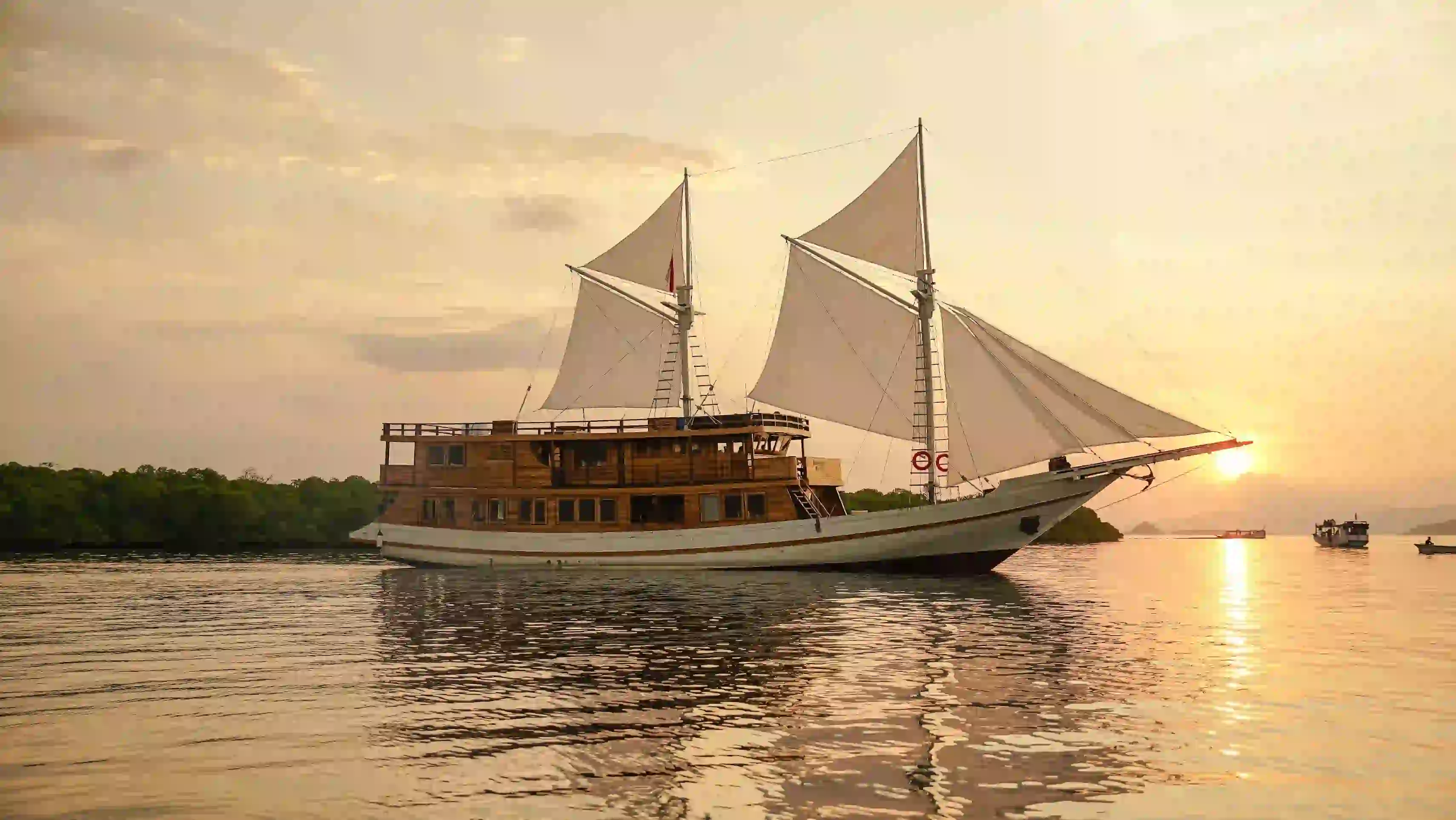
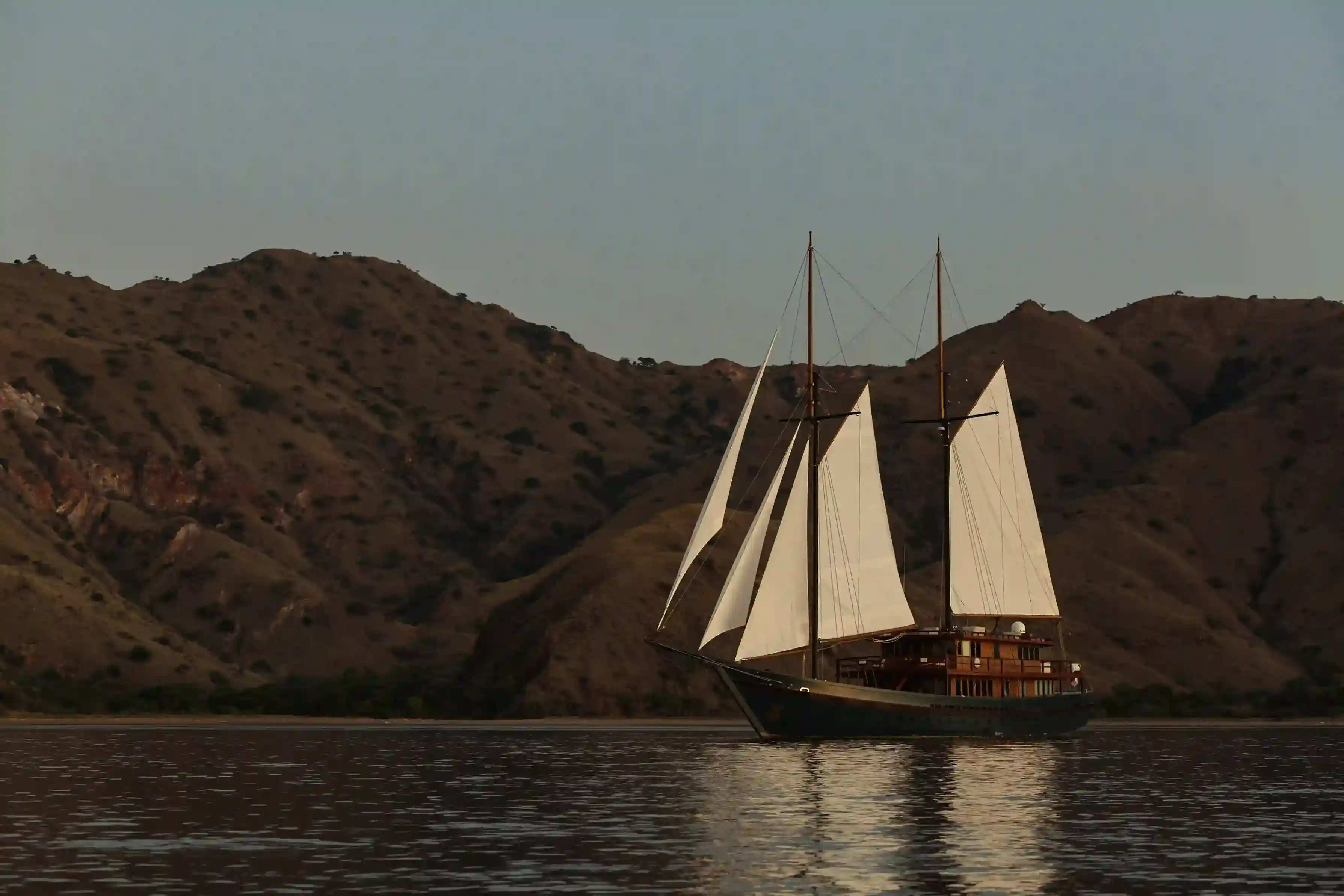
In Komodo, yacht, boat, phinisi, cruise, liveaboard, and catamaran are six genuinely different vessels — not interchangeable marketing words. A yacht is a private, crewed vessel finished to luxury standard. A boat is the honest generic: the value end of the harbor. A phinisi is a traditional two-masted wooden ship, hand-built in Bulukumba, South Sulawesi. A cruise is defined by passenger comfort, not hull shape. A liveaboard is a floating dive base for multi-day scuba itineraries. A catamaran is a modern twin-hull engineered for stability. On the booking side: a charter means you take the entire vessel and its crew; hire (UK) and rental (US) mean exactly the same thing; a trip or tour is a scheduled product you join by the seat.
Last updated: August 16, 2026
We operate out of Labuan Bajo year-round, and the confusion between these twelve words costs travelers real money and real comfort. Every season we meet guests who boarded a day boat expecting cabins, or paid yacht rates for a repainted fishing hull. This page is the reference we hand to guests before they compare quotes. Komodo Boat Charter is operated in partnership with Komodo Luxury — a registered Indonesian PT under Juara Holding Group Limited with 1,500+ verified guest reviews (4.9/5) — so the definitions below come from crews who run these vessels daily, not from a content desk.
| Vessel | What it actually is | Built for | Best suited to |
|---|---|---|---|
| Yacht | Private crewed vessel at luxury standard — en-suite cabins, chef, service crew | Privacy and service | Honeymoons, families, groups who want their own itinerary |
| Boat | Generic term: open-deck day vessels, simple cabin hulls, transfers | Value and function | Budget-conscious travelers, short outings |
| Phinisi | Traditional two-masted wooden ship from Bulukumba, South Sulawesi | Heritage and character | Travelers who want the iconic Indonesian sailing silhouette |
| Cruise | Comfort-led passenger sailing, usually on a set route | Consistency and ease | Guests who prefer a fixed program with hotel-style service |
| Liveaboard | Dive-first vessel: compressor, tank racks, dive deck, guides | Multi-day diving | Certified divers logging several sites per day |
| Catamaran | Modern twin-hull, shallow draft, minimal roll | Stability | Seasickness-prone guests, families with young children |
In Komodo waters, “yacht” should mean one thing: a private vessel finished and staffed to luxury standard, with en-suite cabins, a chef, a service crew sized to the guest list, and an itinerary written around you. Hull material is not the test — several of the finest yachts here are refitted wooden ships. Our Aurora sits squarely in this category. The word gets abused constantly: if a “yacht” quote involves shared decks and a fixed route, you are being sold a cruise seat, not a yacht.
“Boat” is the widest word in the harbor and the most truthful one. It covers open-deck day vessels, simple cabin hulls, and the workhorses that move guests into the park and back. There is nothing wrong with the value end — a well-run day boat under a good captain beats a badly-run “yacht” every single time. But the word tells you nothing about comfort, so make the seller define it: how many cabins, what toilet arrangement, covered deck or open sun.
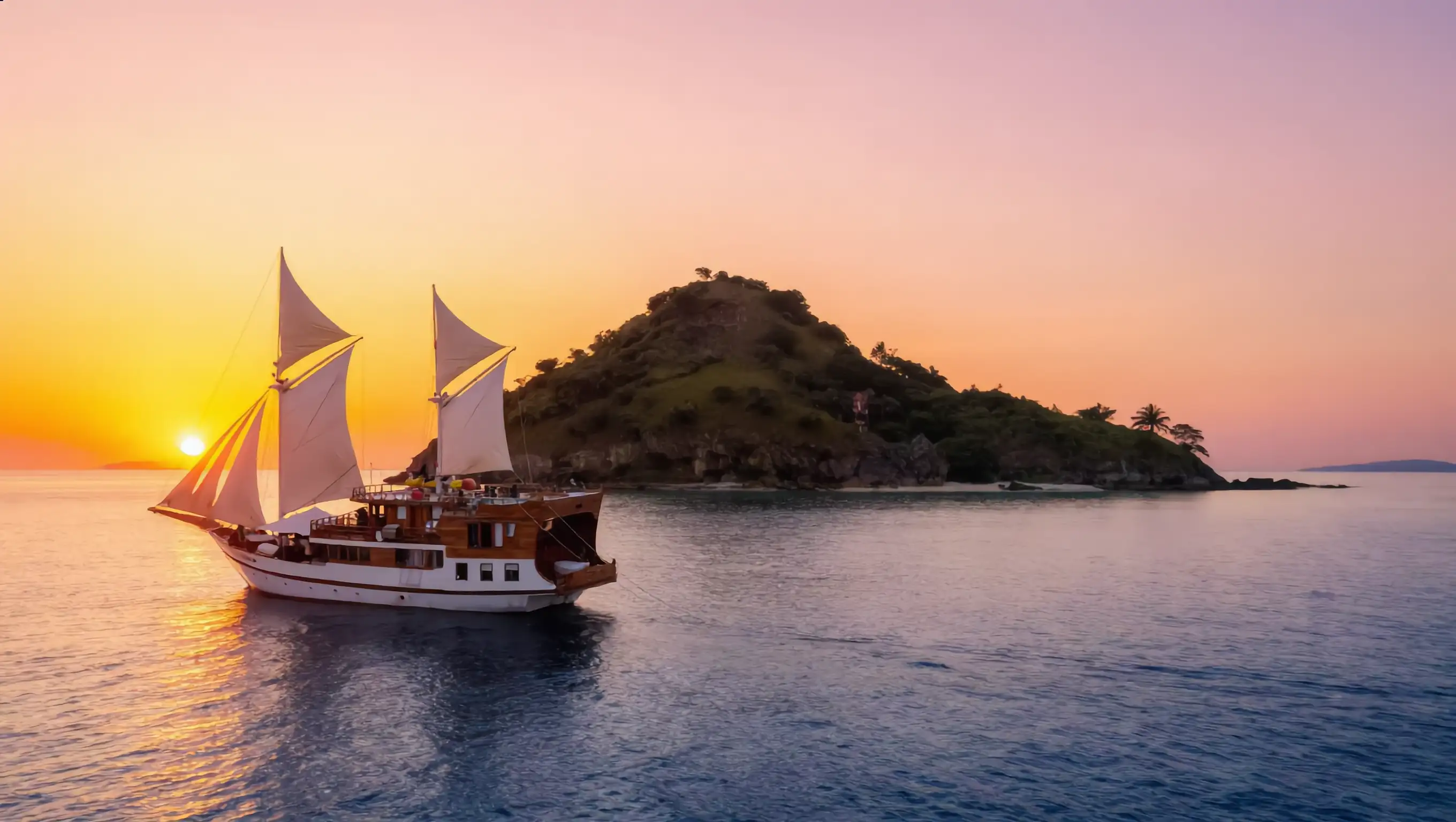
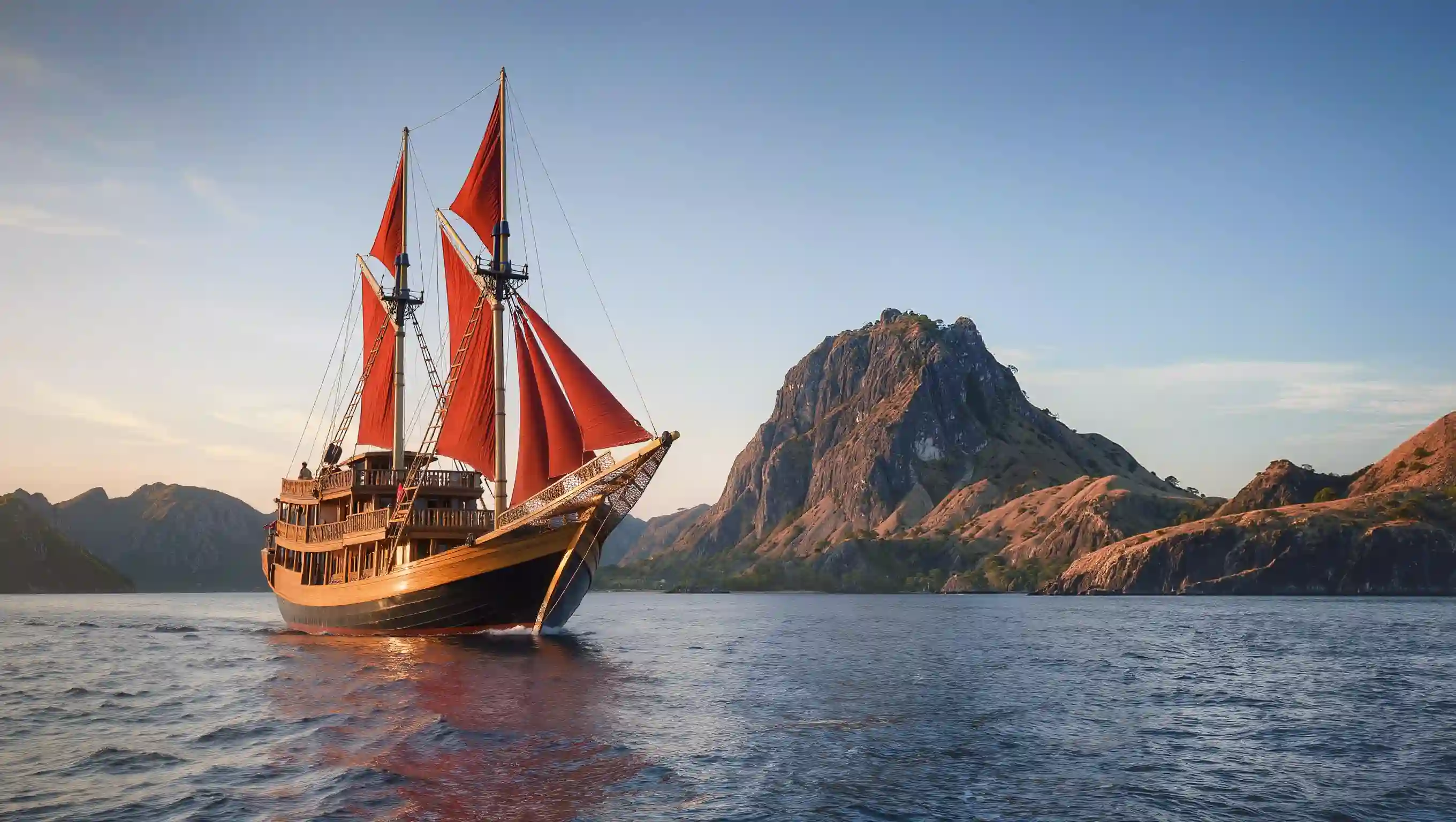
The phinisi is the one vessel type that belongs to Indonesia. These two-masted wooden ships are still built by hand in Bulukumba, South Sulawesi, by boatbuilding lineages whose craft UNESCO inscribed as intangible cultural heritage in 2017. They began life as cargo schooners; today the best of them are refit as charter vessels ranging from simple to genuinely opulent. Our Mawar Biru carries that lineage. One precision worth paying for: a phinisi can be operated to yacht standard, but “phinisi” describes the ship and its heritage, never the service level. Check both.
A cruise is a product, not a hull. The promise is comfort: stabilized decks, proper dining, cabins serviced daily, a route someone else has already perfected. In Komodo the word covers comfortable multi-day sailings on set itineraries. If that consistency appeals more than commanding your own vessel, a luxury Komodo cruise is the right thing to search for — and the right expectation to hold.
A liveaboard is a dive base that floats: compressor, tank racks, a rinse-and-gear deck, professional guides, and an itinerary written around sites and currents rather than beaches. Komodo’s channels — Batu Bolong, Castle Rock, the manta aggregations — reward consecutive days on the water in a way no day schedule can match. Divers short on time can run a private Komodo dive charter from Labuan Bajo instead; for dedicated multi-day dive routes, the specialist Komodo liveaboard itineraries run within our group go deeper into site sequencing than any general charter page can.
Two hulls, one promise: stability. Catamarans heel less under way, roll less at anchor, and draw less water, which opens shallow anchorages the deep-keel fleet skips. They are modern builds — fiberglass, wide beam, big flat social decks — and they trade the phinisi’s silhouette for engineering. For guests who turn green on a crossing, or parents sailing with toddlers, that trade is the correct one.
| Term | What it means | What you get |
|---|---|---|
| Charter | You take the entire vessel plus crew | Your route, your schedule, your group only |
| Hire | British English for charter | Identical contract, different accent |
| Rental | American English for charter | Identical contract, different accent |
| Trip | Scheduled departure sold per seat | You join the vessel’s plan |
| Tour | Scheduled departure with a guided program | Fixed itinerary, shared decks, a guide’s narrative |
| Cruise | Comfort-led sailing as a style of travel | Set route, serviced cabins, ease over control |
The distinction that actually matters is the first row against the last three. A charter means the vessel answers to you. Hire and rental are the same contract wearing British and American accents — search engines treat them as different queries, but no contract in Labuan Bajo does. A trip or tour is per-seat and scheduled: you join the plan rather than write it. Neither model is better; they are different products, and confusing them is how a couple ends up sharing a sunrise deck with thirty strangers. We keep a full breakdown of private versus shared Komodo trips for exactly this decision. One field test: if an ad says “boat rental” but quotes per person, it is not a rental. It is a trip, wearing a rental’s clothes.
Groups that outgrow our own vessels move up to Komodo Luxury’s fleet — Lamborajo, Ayvara, and Malca among them — under the same operating standards and the same crews’ discipline.
Three facts shape every itinerary this year. First, since April 1, 2026, Komodo National Park caps entries at 1,000 visitors per day — a policy that rewards planned bookings and punishes walk-up improvisation, and one we support because Padar at capacity was helping no one. Second, the August 15, 2026 earthquake — magnitude 7.7, roughly 200 kilometers offshore — produced a 0.36-meter tsunami and no destructive damage; harbormasters cleared sailings the same day, which says more about the region’s monitoring and hull standards than any brochure could. Third, the seasons: April through November is the dry season, with calm seas and long visibility — the classic charter window. November through March brings rain and livelier crossings, but it is also manta season, when plankton blooms pull the animals onto the sites in numbers that make divers forgive the weather.
Ask three questions of any offer, from us or anyone else. Am I taking the whole vessel, or a seat on it? What is the hull — yacht, phinisi, catamaran, or day boat — and does the word match the photos? And is the crew’s role defined: full service, or transport with a captain? Twelve words, precisely used, are the difference between the trip you imagined and the one you actually board. When you are ready to weigh specific vessels against each other, our boat types comparison puts every class of the fleet side by side.
the traditional two-masted charter experience
Exploretwin hulls for guests who feel every roll
Explore57 vessels compared, boutique to flagship
Explorehire, rental, charter — the terms decoded
Explorehow each format prices per night
Explorehead-to-head matchups of named vessels
ExploreNo. A phinisi is a traditional two-masted wooden ship hand-built in Bulukumba, South Sulawesi — a hull type and a heritage. A yacht is a service standard: a private, fully crewed vessel with luxury finish. A refitted phinisi can be operated to yacht standard, but the two words describe different things, so always check both the hull and the service level.
A charter means you take the entire vessel with its crew — your route, your schedule, your group only. A tour is a scheduled departure sold per seat with a fixed, guided program. Neither is better; they are different products, and a quote priced per person is a tour or trip, not a charter.
Not necessarily. A liveaboard is the right tool for divers who want consecutive days across sites like Batu Bolong and Castle Rock, since it is a floating dive base with compressor, tanks, and guides. Divers with limited time can run a private dive charter from Labuan Bajo and still reach the signature sites.
Yes. The magnitude 7.7 earthquake on August 15, 2026 struck roughly 200 kilometers offshore and produced a 0.36-meter tsunami with no destructive damage. Harbormasters cleared sailings the same day, and vessels have operated normally since.
April through November is the dry season, with calm seas and the best visibility — the classic charter window. November through March brings rain and livelier crossings but is manta season, when plankton blooms draw mantas onto the dive and snorkel sites in numbers. Note that Komodo National Park has capped entries at 1,000 visitors per day since April 1, 2026, so planned bookings are rewarded year-round.
Only the accent. Charter, hire (British English), and rental (American English) all describe the same contract in Komodo: the entire vessel plus crew reserved for your group. Search engines treat them as different queries, but no contract in Labuan Bajo does.